
What the Toilet Paper Roll Tells You - Pt 2
Geiler Eckman will walk into a bathroom stall and notice if the toilet paper roll is empty. Not because he is looking for something to fix. Because he is reading something.
If someone emptied that roll and walked away, they made a choice, consciously or not, to leave a problem for whoever came next. A small choice. An almost invisible one. But Geiler and his partner and President, Jessica, have run a manufacturing company long enough to know that how people behave when no one is watching, and when nothing is at stake, tells you more about a culture than any value written on a wall.
They see other things too. Dishes left in the sink. The water cooler left empty. Moments where the easier path was to walk away, and someone took it. They are not naive about what these things mean in isolation. People get busy. People have deadlines. But when Geiler sees these things consistently, he knows something is off. And when they start to disappear, when someone refills the water cooler without being asked, when the sink stays clear, he knows something is working.
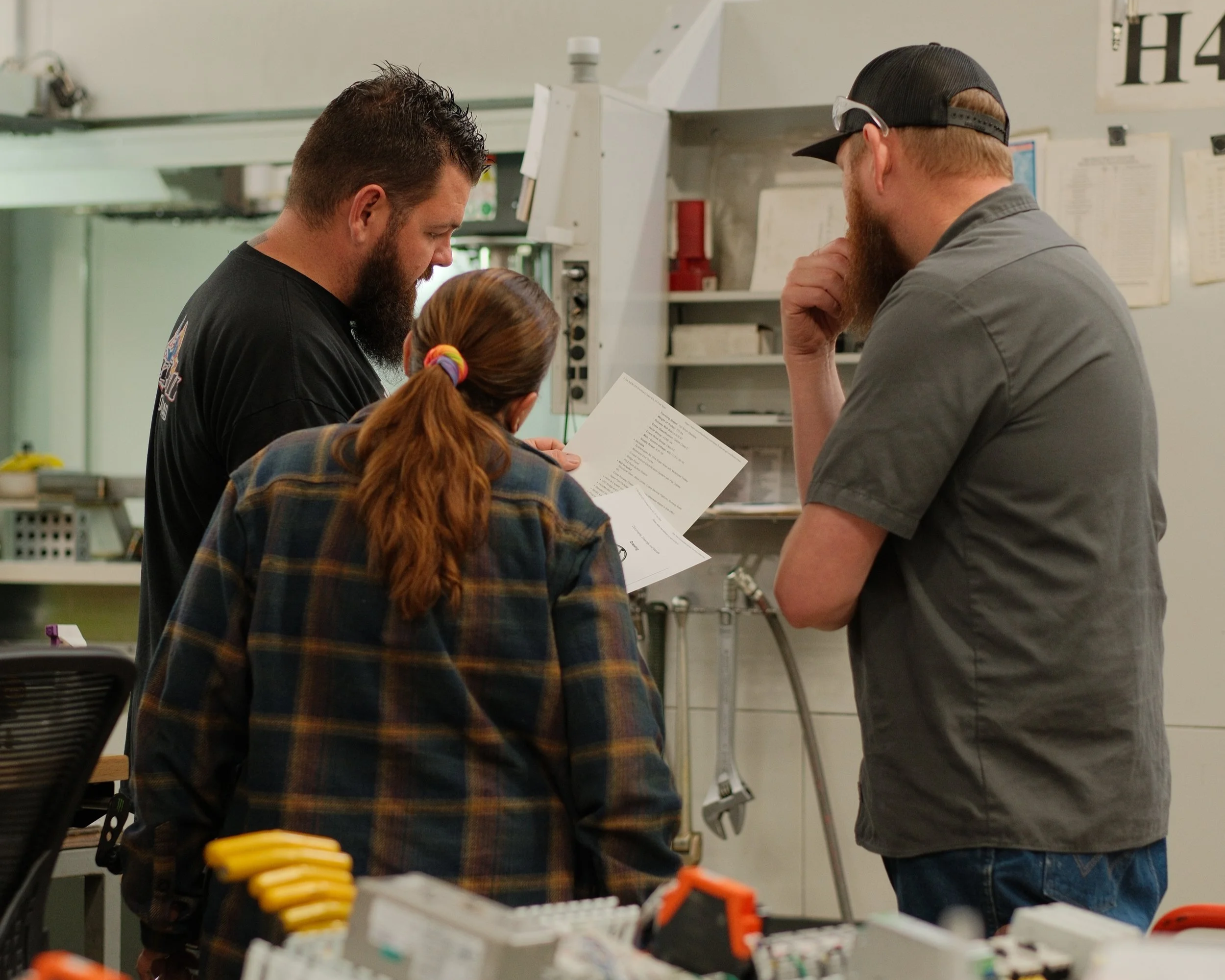
The same instinct shows up at a different scale on the shop floor. The majority of what Bent River builds is new to the world. No previous run. No established process. Just a drawing, a team, and the expectation that what comes out on the other side works. In that environment, nobody can afford to do only what is required of them. The machinist, whose machine is running, notices someone struggling nearby and goes to help. The person who has been here thirty years answers the question from the person who has been here three months. Because it needs to happen, and they are there.
Jessica knows what it looks like when that instinct is absent. A machinist with a machine running, sitting on their phone instead of looking around to see where they can help or what they could learn. She has said it makes her cringe, not out of frustration but out of missed opportunity. The people who thrive at Bent River are curious. They look up. They see what is happening around them, and they find a way into it.
Geiler calls out the harder version of the same problem. The person who draws a hard line around their role and says, "That's not my job." He understands the instinct, though he does not have room for it. Bent River is not a production facility running repeat parts. It is a custom shop solving problems that have not been solved before. It takes people wearing multiple hats, looking around, and asking what needs to be done next. A magic fairy, he has said, is not going to show up and change the oil on the forklift.
What both are describing, underneath all of it, is consideration. The willingness to think past yourself toward the person or the problem in front of you. It is the toilet paper roll that nobody required you to replace. It is the same impulse at every scale.
Culture is not built in big moments, yet those big moments reveal it. It is built in the ones nobody sees, repeated often enough to become a habit, a habit repeated often enough to become who you are.
Geiler and Jessica know Bent River is not there yet. They will tell you that plainly. Culture is a work in progress, Geiler has said, and probably always will be. But he also knows what it looks like when it is working. He can feel it when he walks through the shop. He can tell whether the water cooler and the toilet paper are full.